The Phantom of The Opera

Ridley: We’ve been to the musical, Phantom of the Opera. Both Latimer and I went to see this in the Grand Canal Theatre in Dublin (now renamed the Bord Gais Theatre, though everyone refuses to call it that!)

Latimer: It’s a real shame that the theatre was renamed, because the ‘Grand Canal’ makes it sound very opulent and grand, but the Bord Gais (‘Gas board’ in Irish.. because the Irish Gas Board sponsor it now) makes it cringe-worthy. 

Ridley: It was really fantastic going though, name choice aside! I don’t often go to the theatre, but when I do go, I always wonder why I don’t do it more often, as I feel quite cultured! 🙂 The costumes were so vibrant, the set design was clever and the music just swept you along. If you ever get a chance to see this in theatres, go, you won’t be disappointed! Your eyes will just want to drink it all in!

Latimer: Myself and Ridley went to see Lord of the Rings, the soundtrack score in this theatre (‘Grand Canal’ at that point). I remember complaining that the seating was bad (we were about three rows from the front). And the layout felt very cramped.

But this time I was sitting on the upper circle and it was pretty fantastic. I recommend that seating area now! I went with my Mam and Aunt, and my Aunt has been to this theatre lots of times and she knows what seats to book now.

Ha. I suppose it’s trial and error.

And in introducing my Aunt, I introduce an old, old fact from the Grand Canal’s medieval past- a detour through time now if you will!

Outside the theatre, there are many red poles (as you see above).

Ridley, did you ponder, what these meant? I didn’t give them a second thought, only thinking; ‘oh, some arty poles’.

Ridley: I have asked before ‘what’s with the red sticks’ but no one ever knows! I’m sensing you do…

Latimer: Ah, my Aunt told me that they mean something…

There’s a street opposite the theatre called Forbes Street. And in medieval Dublin this was were the lepers were sectioned (it was known as ‘Misery Hill’).

The red poles are symbolic of the saying, ‘I would not touch them with a barge pole’ in reference to the lepers.

Very eerie now in that respect eh?

By night the poles are lit. The above picture is them after the show was finished!

Well now… back to the Phantom! I agree that the set-design was fantabulous! My god I couldn’t get over it. Ridley, please, explain the story if you will…

Ridley: Well, most people know the story of Phantom of the Opera. For those that don’t, it’s basically a tragic love story. The phantom is a deformed man, a ghost who lives in the depths of a theatre. He falls in the love with the young and beautiful Christine Daaé. He watches her from the shadows and teaches her to sing without revealing himself. She believes he is her Angel of Music, a being from heaven sent by her father to watch over her. It is the phantom that arranges for Christine to get her first big break in the theatre. He bullies and forces the owners to feature her as their star. While she is singing as the lead in the play, her childhood friend Raoul sees her and they reconnect. Thus begins the dangerous love triangle, where Christine must decide between her old friend and her Angel of Music.

The 2004 movie with Gerard Butler is the version that I know best. Not a bad version of the phantom to love, Gerard Butler, eh? Teehee. It’s a bit like Doctor Who, everyone has their favourite Doctor and everyone has their favourite phantom! Gerard is mine! (I also have the soundtrack from this version of the Phantom of the Opera and I play it often. It’s really beautiful.)

Now, I’ve always thought Christine should have chosen the phantom over Raoul. My view on this has never changed, no matter how many times I’ve seen the musical-either in the theatre or in the cinema. Raoul’s affections always seemed so fleeting and shallow. He only remembers his love for her when he hears her singing at the opera-after she’s become the lead performer. Whereas the phantom has loved her all this time, helping her and protecting her…

Dramatic, mysterious, passionate and powerful, that is what the phantom is for me. I’ve always found myself drawn to him. I suppose I’ve always liked the bad boy, the evil genius. The phantom had the swirling black cape, a mask framing eyes that captivated and a hidden lair that he filled with haunting music. At the same time, he was damaged and vulnerable in some ways. Raoul was always pathetic compared to him. He also certainly didn’t get the massive swells of music from the organ at his sudden appearance.

With regards to Christine, I don’t think I’ve ever liked her as a character. On one hand, I can understand that she’d be terrified of the phantom, having been suddenly kidnapped by him. He is quite menacing. But I can’t seem to shake the soft spot I have for him, despite being a kidnapper and a murderer (I seemed to have glossed over this part in past versions, I’d forgotten about it but I was abruptly reminded he killed a stage hand, when I watched the musical in the theatre the other day! The sympathy I feel for the phantom is certainly diminished when I take this into account, so I generally have to forget this happens!)

I think that Christine uses the phantom. She preys on his vulnerable side, the side that has never seen friendship or love. He’s had only hatred, disgust and fear thrown at him. Without him, her career wouldn’t have progressed as far as it did, nor would she have been able to sing like she does. She plays on his affections for her and then betrays him in the end.

Latimer: Actually watching it all again, in this form, I can understand her not loving the Phantom though. Because he wasn’t sympathic and he was pretty ruthless. I remember in the movie thinking, ah she should have picked the Phantom (I was annoyed that she didn’t to be honest!).

Yet in this musical version (possibly the real version- aside from the book!), I felt it was all mixed up, I didn’t like the Phantom. The characters I really liked were the two men who buy the theatre at the start. I found them funny and enjoyable (light-hearted among the grimness). My Aunt saw it in London and said that this Dublin version has been cut down alot, so we missed out on some backstory etc

Ridley: The funny thing is that all changes in the sequel to Phantom of the Opera, which I never realised existed! It’s called Love Never Dies, and I have some major problems with it. (Spoiler alert here)

Latimer: This is beyond ridiculous…!

Ten years after the events of Phantom of the Opera, the phantom tricks Christine and Raoul into coming to New York, where he wants to hear Christine sing once again (I’d like to point out, his love for her still hasn’t faded!) Christine has a son, Gustave. It turns out that this is the phantom’s son! (My jaw dropped at this! Latimer: what the Dicken’s? haha, this is just so bad!) Never, not once is there ever any hint that Christine and the phantom were in anyway intimate in the musical or the films. Perhaps this occurs in the book? (which i’ll admit I haven’t read, so i’m very open to being corrected on this) Not only this, through the phantom’s scheming, he convinces Raoul to leave Christine, which he does-without any fighting to save their marriage! Then suddenly it seems Christine has always loved the phantom and she finally stops fighting against this love. Based on the musicals I’ve seen, I would have always said she’d felt nothing but pity and disgust for him. Perhaps at most, she had an affection for her Angel of Music, but no this undying love. 

Latimer: She found this false, undying love very quickly, considering how she left things in the Opera house in Phantom of the Opera. I’m still shaking my head at this. It was obviously fabricated in light of creating another cash cow.

Incidentally, he’s (the Phantom) running a theme park in Coney Island when we meet him again in ‘Love Never Dies’. And it’s called Phantasma… oh my…. oh my… 

Ridley: Well, also, the other final thing I have a problem with is when Gustave finds out the phantom is his father. He decides to stay and join him at the theme park in New York, instead of following after Raoul when he leaves. Raoul is the man he’s known all his life, the one he’s always considered his father and yet he wanders off with this random stranger instead? What? Would that really happen? I don’t think so! Hmm…

All the same, despite all my nit-picking and wish to change the ending, I still love the story! I think there are quite a number of people out there that love it too, or am I wrong? 🙂

Latimer: While I really enjoyed my trip to the theatre and also, the set design and experience of the musical was just amazing, I don’t actually like the story of Phantom of the Opera.

But still, it was a nice night! Also, random that we both attended separately, but we have joined together, like bubbles caught in an updraft to write this post. After-which we’ll pop, likely never to speak of it again! Ha 🙂

Ridley: Yes…bubbles…..  *pop*   😀
Now for Something Completely Different

Latimer is made of star stuff? Hurrah!

Latimer: Okay, so in this post I well and truly get my nerd on. What follows is an indulgence of my science fetish!

It might come as a surprise that I am a factual being, when my dreams are so rooted in the fantastical. But sometimes the truth is just as mysterious and awe-inspiring as the dream. I think that science is the great dream; the greatest mystery.

Recently I went to a general science conference, covering everything under the sun. It was the European Science Open Forum (ESOF) which was held in Dublin this year (Dublin is the City of Science for 2012 🙂 ).

This conference was incredible; for a start the program included five Nobel Laureates. Heavy-hitters as I was calling them.                                                                                 

The conference had two speakers that without a doubt I had to see: Prof. James Watson and Dr. Craig Venter. They’re like celebrities in science.

Now, you may or may not know who these men are. If you don’t, let me explain…

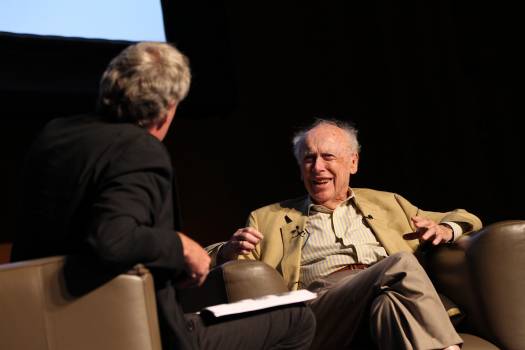
A conversation with James Watson

Professor James Watson, co-discoverer of the struture of DNA

Prof. James Watson co-discovered the structure of DNA in the 50’s with Dr. Frances Crick. He is quite an incredible man- at 84yrs of age, he is still active in research today!

The talk was a ‘conversation with James Watson’. It was very interesting. He can be quite controversal though.

He wrote a book called How to Avoid Boring People; one interest thing he said was to avoid being in a room with more than 2 Nobel Laureates (you have to laugh at the likelihood of that happening).

Watson said he hated going to the Nobel meetings because you end up with 10 Nobel Laureates in a room and they are incredibly boring. He snorted thinking you’d have to be boring to be one and that he was the exception.

It was amazing to get the opportunity to see him.

Dr. Craig Venter: ‘From Reading to Writing the Genetic Code’

Dr. Craig Venter, the background shows the cover of Science, the journal in which his group published their sequencing of the human genome in 2000

Dr. Craig Venter, sometimes called the ‘bad boy’ of science, was involved in the sequencing of the human genome. There were two groups racing to sequence the human genome at the time; the public group led by Dr. Frances Collins and the private group lead by Venter.

Venter had declared to the public group that his company could sequence the genome faster and for cheaper than they could. This kicked off the race between the two groups, leading to the genome being sequenced far faster than the public group had estimated it would be (3yrs ahead of the expected time-frame).

Craig Venter’s synthetic micro-organism, a bacteria called Mycoplasma mycoides JCVI-syn1.0

In recent years, more famously perhaps, Venter’s research group made the first synthetic organism.

It was very interesting to hear what his group (or an assembly of many groups) was up to and also to hear his thoughts on the future of science. 

He believes, for example, that in the future, during disease outbreaks, it will be possible for people to download vaccines from the internet and use boxes, containing his technology, to synthesize the vaccines themselves.

What an amazing thought eh? And not that farfetched.

Prof. Brian Greene: ‘The State of String Theory’

Professor Brian Greene

This was an incredible talk (even though I don’t do or understand Physics!). I am fascinated by the science of the universe.

Did you know- the heavy elements in our body came from the heart of an exploding star? All the particles that make up this universe have always been and always will be; how incredible is that?

It leaves you with a sense of belonging to the universe.

Prof. Greene also mentioned the multiverse- the notion that we are only one of many universes.

If these multple universes exist, it is believed that they would collide with one another and cause ripples to pass through each universe. 

Prof. Greene said, if we could detect these ripples, we could prove the existence of other universes. He said people were working on searching for these ripples (and they would be possible to find, if they exist).

Wow.

The infamous strings of String Theory… hypothecially!

Specifically though, Prof. Greene was talking about String Theory.

The idea behind it is that, if proven, it would be the unifying theory of physics- explaining all the parts that make up the whole universe and the energy in it.

It is a very complicated idea, and one that I can’t explain- so I found this brilliant TED talk that Prof. Greene gave (and it’s very similar, down to the letter in some parts, to the talk I heard). It’s about 20mins long, but it’s fascinating and he explains it in a clear way, so it’s easy to follow, if you are interested, I highly recommend it!

I left his talk feeling invigorated, awed and amazed. I had to jot down all I could remember.

Prof. Rolf-Dieter Heuer: The search for a deeper understanding of our universe at the Large Haldron Collider: the world’s largest particle accelerator

Large Haldron Collider at CERN

I couldn’t miss this talk. CERN is all over the media at the moment.

Prof. Rolf-Dieter Heuer (a particle physicist and Director General of CERN) was talking about the Higgs Boson. Which he said, if you ask him professionally he would say, ‘we have probably found it’, if you ask him personally he would say, ‘we have found it’.

Scientists, we are always so careful!

Professor Rolf-Dieter Heuer, Director General of CERN

He was a brilliant speaker, very funny and very interesting.

Professor Peter Higgs, Theoretical Physicist who first predicted the existence of the Higgs boson

Briefly (and in a very simple way, because I am no physicist!), the Higgs Boson, when found (as it likely has been), would prove the existence of the Higgs field.

The Higgs field is the way a particle gains mass (by interacting with the field). The stronger the interaction with the field, the larger the mass of the particle.

The field also has a peculiarity, in that, it can interact with itself.

So, again, a particle gains mass by interacting with the Higgs field, in theory, but in order to prove that the field exists at all- you must find the Higgs boson.

But why?

Why would finding the Higgs boson prove the existence of the Higgs field?

Prof. Heuer had a brilliant way of explaining the reason why:

He used this analogy: if he walked into a room full of journalists (representing the Higgs field). He could pass through the crowd, unnoticed, because they don’t know who he is.

The journalists don’t react to him.

Professor Rolf-Dieter Heuer, Director General of CERN… pointing!

However, if Einstein passes through the crowd, the journalists will react and crowd in on him.

And so Einstein gains mass (which is what the Higgs field does to particles).

The more known to the journalists, the more massive that person becomes (as they are all crowding in on them).

This is an explanation of how a particle gets mass in the Higgs field.

But, Prof. Heuer said, if for example he whispers a rumour into the room of journalists. They start to crowd in on each other, saying, “what did he say? Oh? Who?”.

This is a self-interaction of the field.

This forms the Higgs boson- self-interaction of the Higgs field= Higgs boson!

WOW! We all cheered. What a perfectly simple explanation of something I did not understand at all.

Professor Rolf-Dieter Heuer, Director General of CERN
“So, particle physics is really easy!!”

After he explained this, Prof. Heuer said: “So, particle physics is really easy!” (His wry smile implied he was making a funny; everyone laughed).

You might wonder, this is all very well and good, but how does the Higgs boson help us really?

Well, Prof. Heuer made this point; the internet was developed in the 80s at CERN. It was developed by the scientists so they could transmit their research to one another in a quick manner. At the time, they didn’t envisage any other purpose for the internet. But in later years, obviously they realised it could be used for other things. And it was only later that other uses became known.

Prof. Heuer doesn’t know yet what the Higgs boson can be used for, but in the future who knows?

I really loved this talk.

Prof. Heuer is amazing. I want to go to CERN and follow him around and have cups of tea with him and get him to tell me about the universe!

Would it freak him out? If I was in his shadow, with a cup of tea in one hand and a notepad in the other, going:

“Okay Rolf, tell me about the universe!” Latimer

“How did you get in here?!” Rolf

“I live here now…” Latimer

“Security!” Rolf

“Shush; I locked them in the Large Hadron Collider- anyway, let’s talk physics!” Latimer.

Ha…

‘What does Art bring to Science?’

Moving away from Physics now, I also went to a series of talks on; ‘What does art bring to science?’

The most interesting of these was the story of an American painter, William Utermohlen, who had been diagnosed with Alzheimer’s disease. This of course is incredibly sad, but Mr. Utermohlen gave a valuable, as before unseen insight into this progressive, destructive disease, by charting its progression with his self-portraits:

I found them haunting and somewhat disturbing to be honest, particularly the final portrait. It does illustrate a clear decline though, in a media that had not previously been shown.

It gaves the disease a very human element.

This was a very interesting talk; Mr. Utermohlen’s story really stuck with me.

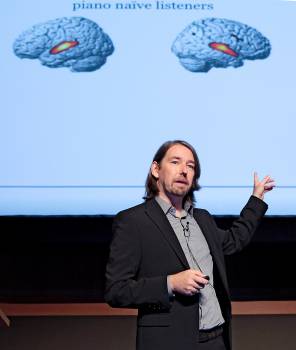
Prof. Christian Keysers: ‘The Empathic Brain’

Professor Christain Keysers

Carrying on from this, I delved a bit more into the brain.

This was a brilliant talk about the biological basis of empathy.  Prof. Keysers gave an overview of empathy research.

He explained to us that empathy is not localised in a single area of the brain, rather empathy for different things is localised in different areas of the brain.

So,  people with damage to the brain, could loose the ability to feel certain types of empathy, but retain the ability to feel other types.

In terms of loosing the ability to feel empathy, Prof. Keysers said, if you loose the ability to feel e.g. disgusted, then you also loose the ability to feel the empathic disgust of others.

There was an interesting study carried out, where two groups, one male one female, were shown a card game. While they watched, the researchers monitored their brain activity.

The groups were shown a person playing fair and a person cheating, and winning. The cheater was punished and given an electric shock.

While watching the fair plays, both men and women had the same empathy levels. While watching the cheater being shocked, women had slightly reduced empathy, but they still had some empathy (sharing the cheater’s pain at being shocked).

However, men had no empathy while watching the cheater being shocked- in fact, it had activated a reward sensation in the brain! Indicating that the men were happy to see the cheater being punished, while the women were still empathising with the pain the cheater felt!

This begged the question of men and war, versus women and war. That perhaps there might be more psychological impact on women and this perhaps should be monitored more carefully.

Interesting right?

There was also a study carried out on ‘reading about emotions’. This study showed that people could empathise by reading; for example, they had a paragraph describing something disgusting and people felt disgusted by reading it.

The study suggested that people who read more may have more heightened empathy; but the reason why is not known.

Is it because people read more, that they have more empathy? Or is that they get more out of reading because they have the ability to empathise more with the characters (and that’s why they read more)?

Prof. Keyser mentioned something his old poetry teacher, from school, told him and it sort of stuck with me in terms of writing.

The teacher said that if you want to describe a person sailing on the ocean for the first time, don’t tell your readers what the ocean looks like, they already know- tell them about the person.

Tell them about their expressions. This is more informative, because this way they empathise more.

And in a scientific sense, you are activating the right parts of a person’s brain to feel attachment to your characters. So talk about the person, not the scenery.

Prof. Keyser wrote a book called The Empathic Brain and it’s a self-published one.

It describes an overview of empathy studies (not just his own). I haven’t read it, I did buy it though, it’s waiting on the Kindle- with many others, ha. But he said it was for everyone, so it’s not written in an overly scientific way.

Well, the conference was absolutely amazing.

I wanted to share some of the things I learned, though I appreciate that I might have rambled on a little. I hope it was clear and maybe a bit interesting in some way!

Being at this conference reaffirmed my love for science 🙂

Book Trailer Unleashed!

Ridley and Latimer have been turned into chibis! Ridley: I only need one eye, like Sauron… Latimer: Takoyaki (octopus balls) anyone? No.. I didn’t think so.

Well, the book trailer is done! Here it is, as we promised! It’s all our own work (animation and art).

Hope you like it!

_________________________________________________________
Product description of Legend Unleashed
 
When an infamous criminal is unleashed from his prison, it has consequences for everyone in Carwick. Temperance Levinthal in particular…
Temperance is satisfied with her ordinary life. Dealing with her eccentric, childlike parents is all the excitement she needs. That changes when Alastair Byron returns home.
After a failed matchmaking attempt by her father, sparks fly between her and Alastair-just not the good kind.
They are forced together though, when they are implicated in a grisly murder. Their search for the truth leads them to a secret world beneath Carwick, filled with werewolves, wizards and other magical faey.
However, uncovering the truth is far more dangerous than they’d ever imagined.
There are secrets within secrets.
Even Alastair may be more than he seems…
_________________________________________________________________

Ridley: It’s a stop motion animation with black silhouettes, kind of in the style of Lotte Reigner. Here’s some of the pictures below that I took while making it- and when I remembered to take them!

From drawing rough sketches of the different scenes and characters.

From cutting out the silhouettes.

From recording the animation.

The animation was carried out in my garage room (as you can see from the clutter! Go look back at the picture of the camcorder, do you see the empty Tayto box from many Christmases ago? Told you we love crisps in Ireland-see the post Irishisms, if you’re now going ‘Huh?’) Despite the chaos, this was the darkest place in the house, so the best room for animation creating! In a way, I made the light box. It’s a long frosted glass table that I got second hand (at an excellent price) and I went to Woodies (local hardware shop) to buy a light, which I placed underneath the table. It beat paying a 100 euro plus for an official A4 light box. The tripod and the camcorder aren’t mine, they were borrowed!

Latimer: At this point, please imagine me texting, and viber messaging Ridley, saying ‘how’s it going? yeah, yeah? Harder, monkey! Work harder!’, sipping my tea, crackin’ the whip. Editing on the side 🙂 (as Ridley bled real blood, I bled metaphorical editing blood).

Ridley: I recorded the frames of the animation with the programme ‘I Can Animate’, then I used Windows Movie Maker to gather the clips and create the video. Audacity was a programme I used for the music and sound effects. It’s fantastic to use, quite simple once you learn the ropes.

Latimer: I wish I could have strapped a camera to Ridley’s head while she did all of this. Because I would have loved to hear the, ‘oh dear god, noooo! what happened?’ moments. Next time, I will- I’ll document it!

Ridley: Latimer and I collaborated on it all (Latimer: she’s being nice, the animation is Ridley’s brain-baby- I was a sound-board for the story-board, music and descriptions- but really props to Ridley for this!), deciding on what worked in the animation once it was recorded, the font used on the slides and the type of music we needed to create the right ‘feel’ for the trailer.

For the parts like the chains behind the clock and blood drops, I used Deleter screen, which is used all the time by manga artists. The paper has grey tones and designs, which can be cut out and stuck onto your picture. It’s great stuff. I bought it with the trailer in mind when we were in Tokyo after we found one of the best art shops there, Sekadio in Shinjuku (Latimer: working holiday, the only way to holiday! Haha!).

 We were in heaven, except for the fact it was packed and all the aisles were really narrow! And I am a browser, I wander the aisles, which you couldn’t really do there! (Latimer: yeah, poor shop design really too narrow! and claustrophobic!)

Overall, I had an absolutely fantastic time making this. It’s my first ever video, though I’ve always had a love for animation, second only to writing! Most of my favourite movies are animated. Aardman, Pixar, Blue Sky Studio, Dreamworks-I love all their stuff. In Ireland, we’ve Brown Bag films,  Boulder Media and Cartoon Saloon to name but a few of the companies here, all of which are making waves in the animation industry!

So as you can see, I relished the chance to create this trailer and join my two great loves, writing and animation. I just really hope people like it!

The 47 ronin

In the damp wet of Ireland’s ‘rainy season’ (a.k.a. summer), Latimer thinks back on ancient Japan. She exchanges her wetsuit for some samurai swag and sets off on a journey through Japan’s shogun past…

Latimer: Modern Japan is fantastic. Don’t get me wrong, I love it. It’s fun; it looks crazy, but it does leave me thinking, ‘that’s intense… sort of unreal’.

The Japanese past is sometimes hard to find in Tokyo.

But find it you must, because it’s full of fantastic stories waiting to be told!

We were on a pilgrimage of sorts that day. We wanted to find the temple of the 47 ronin- otherwise known as Sengakuji!

My Dad was the one that told me the story of the 47 ronin (master-less samurai). I’m not sure how or why he came to know the story; but he told it to me in his ‘every single detail’ manner…

The story begins in the age of the shogunate… I will attempt to set the scene… actually I may have to leave it to your imagination because my historical knowledge is firmly European. I could tell you to imagine a castle, a wild windswept hill; rough spun tunics and broad swords… but I won’t because I’d be wrong, your picture would be wrong and we’d all be looking at Braveheart and that’s not right! We are going to the orient after all….

The shogunate age was the golden age of the samurai and their masters. The samurai were a noble class and they followed a strict code called bushido. This was all about honour. Honour and respect; that was key to the samurai- you could lose your honour very easily back then it seemed. We use the term perhaps a little dismissively today- but back then, to them, it meant something…

Asano Takuminokami was the Feudal lord of Ako. He was asked by the shogunate to entertain vistors to Edo (the old name for Tokyo). Asano asked his loyal advisor Kira Kozukenosuke for directions on how best to do this. Apparently Kira didn’t like Asano and ‘with malice’ disgraced his honour as a samurai (bad mouthed him basically. This was a major no-no in bushido!). Asano decided to put Kira in his place for insulting him. He drew his katana (sword) and managed to cut Kira on the forehead- but not kill him (ah fiddlesticks!).

It was strictly forbidden to draw your sword in Edo castle. There was also a law that stated ‘equal punishment for quarrels’ so both men were expected to be punished. Now the story gets foggy here, but for some reason Kira got off the hook and only Asano was punished. He was forced to commit seppuku (samurai suicide, not to be too graphic but it involved a knife to the stomach and then your stomach on the floor- grim). Anyway, Asano was forced to commit seppuku in the garden of another lord’s house. This was bad, because seppuku outside was for felons not a lord like Asano. And as if that wasn’t bad enough- his family were stripped of their titles and forced off of their estate!

Asano died and Kira got away scot free! Oh… that’s the perfect start to a story of revenge if ever I head one! The loyal samurai of Asano, the Ako Gishi (47 of them), pleaded against this indignity and demanded the reinstatement of the Asano house.

They were denied. And so began two years of plotting…

They set their plan of revenge in motion on December 14th 1702. They attacked and killed Kira at his residence. Apparently they pleaded with Kira, treating him with respect, to die as a true samurai should (commit seppuku and die with honour). The leader of the 47 samurai, Oishi…

… offered Kira Asano’s dagger (the one he had used to killed himself). Kira trembled before them, but would not kill himself. So, they did it for him (dishonourable) then cut off his head, taking it to Asano’s grave in Sengakuji.

One of the 47, named Terasaka Kichiemon, was ordered to go to Ako to report that revenge had been taken.

Strangely now, the 46 remaining ronin didn’t run. To run would be dishonourable. They turned themselves in to the shogunate straightaway.

They were sentenced to seppuku the following February 4th and buried in Sengakuji with Asano. In a strange twist, Terasaka Kichiemon was pardoned by the shogunate when he returned from Ako. Some reported it was due to his young age. Terasaka Kichiemon lived to be an old man; he died in his 80s and was buried next to his comrades.

And after hundreds of years, myself and Ridley found ourselves at the 47 ronin’s graves in Sengakuji.

It was one of the quietest places we had been in Tokyo. Tucked away from the bustling modern world (though that world did overlook the small temple).

When we got there, it felt like we’d finally found ancient Edo, beyond the lights and noise of Tokyo, behind the modern facade.

The story of the 47 ronin is one of the most popular stories in Japan, because it reminds them of loyalty (Chu) and justice (Gi).

There were no tourists there. The place was serene. It had history. It had a story. I’m in two minds about the samurai notion of honour. It’s an extreme version that I don’t understand to be honest. Then there’s the loyalty part, which is somehow easier to connect with. These men sacrificed their lives to avenge their master. There is something very powerful about that level of conviction.

It was amazing to finally see the place; amazing how such an old story, from so far away, could have found its way through time and tide to us. We were very touched and awed! (Thanks to my Dad for telling us about it!)

Sleep vs. Book: the cost of addiction

Latimer: Two nights in a row I’ve been up until 1.30am. And that’s not good when you have to get up at 7am!

I ended up watching episode 2 of Game of Thrones on Tuesday night. It was pretty crap actually- too much talking and gratuitous sex. My flatmate (Orbie) made a very good point about the sex, “why is it never the ones we want to see naked?”

“Fair point,” I said. “Like Robb Stark.”

Orbie nodded, “And Jon Snow- the hottest things in the show.”

Silently, I nodded, this is true, but then I chirped up, “And Jaime Lannister?”

She didn’t reply. Is it just me? I’m going to wait for Ridley to shoot me down on that (I don’t expect her to, but the heart of a woman is a fickle thing. We find beauty in strange places at times and expect others to loudly declare they are sisters in arms with us, when in actuality they look at us with scorn and reproach! But then in turn, we’ll do the same thing when they come forward and admit their guilty pleasure!).

Anyway, so we watched Game of Thrones.

Then, I headed to bed to finish reading Book 2 of the Hunger Games (it wasn’t my intention initially to finish it, but that’s what happened- like a crack addict I OD’d on reading). I stumbled, bleary-eyed to the bathroom at 1am (1 chapter left at this point). As I passed Orbie’s room, the light was on (this was weird). “Hmm,” I thought. Then shrugged, stumbling back to my room to finish gobbling down Book 2.

I woke up the next morning in a hazy half-dream state. I thought I was in the games for a minute, in some weird trippy after-effects of late-night reading. I shook my head and struggled off to make my breakfast. It was a while before Orbie materialised, clawing her way out of her room like a drunk, doped-up koala. She stood blinking in the kitchen, “I’m so tired!” she moaned. “My eyes are burning! I can’t keep them open!”

I nodded, munching my toast. “Hmm, I know what you mean I was up last night reading.” Pause. “What time did you go to bed at?”

“2am!” she cried, using her fingers to hold her eyes open.

“What were you doing?” I inquired. My mind connecting the dots… I wondered….

“Reading.”

“What?” I pressed.

“Hunger Games Book 2!” she said with a sheepish smile, as if I would shoot her down.

“I knew it! Me too,” I squealed.

I told her I’d been up the previous night too. She asked if I had the one’s with the crap, horrible, garish covers (yes).

She scowled, “Those covers make it look like you are reading a kids book about aliens.”

I told her about how Ridley and I had gone to the bookshop after the movie (I’ll set the scene: movie ends, Ridley turns, a knowing smile on her face; “bookshop” she asks, but it’s not really a question. I squeal like a child on too much sugar “YEEY!”- she knows me too well).

Orbie levelled a knowing look at me, “I told you, you would like it” (she had seen the film the previous week and told me, “you’d like it; it’s very good”).

I sigh, “Yeah, yeah, you and Ridley!”

Then, Orbie and I stumbled off our separate ways to work.

I’m saving Book 3 for the weekend. I have it under lock and key. I have to, I need sleep!

My name is Latimer and I’ve been Hunger Games free since 1.30am on Wednesday.