Murphy’s Law

Latimer’s week read like Murphy’s Law.

Latimer: A series of unfortunate events leads me to writing this entry. It’s basically a more somber version of Ridley’s.

Firstly, the number one thing you need to understand is my laptop is not a thing. It is actually an extension of myself; and so, I am currently suffering from phantom limb syndrome, because said extension has been removed from my person.

I should preface what comes below by stating emphatically  I am a laptop addict. That’s a fact. And even though, I will often say this in a joking manner, I am in fact deadly serious. It’s not as insidious as a blatant addiction to say, alcohol or drugs, but actually it’s just as real. The scary thing, and the thing I often ignore, because it’s not something I like to dwell on, is that I am in fact addicted to my laptop and the internet. However, I think this is an expected addiction of the modern age (you can tell I’ve had a lot of time to dwell on it, in light of being separated from my laptop). The edge has been taken off by virtue of the fact that I own a smart-phone and therefore have an internet-based outlet.

The whole event started on Monday night.

I tried to turn on my laptop and it wouldn’t start. I tried again, and again and again. But my beloved was having none of it. I wasn’t as concerned as I expected I would be. Usually such an event is followed by nervous lip and finger biting, and heart palpitations (this, is what my naïve mind assumes is a very, very, very mild form of withdrawl symptoms!).

When things happen to my laptop, on this scale, my find is filled with white noise… a blankness as if someone has stuffed cotton wool into my brain, leaving me to float in a cloud of despair.

This despair was present but at very low, semi-undetectable, levels. I was able to breathe and knew there was nothing I could do. So I stopped trying and decided I would go to the ‘IT crowd’ in my college the next day and see what they could do.

I slept well that night. I was in the ‘acceptance of powerlessness’ stage!

The next day I handed it over to the IT crowd. That was like walking into a wondrous world I didn’t understand- the world of hope for the uninitiated! I know what technology can give me, but when it fails (as badly as it had) I’m lost, baffled, confuddled. It was like I was a child, handing over my laptop to God, going; ‘Pluh-ezz Mister, can you fix it?’

I left it with them and went to work. As I muddled around the lab, time ticked by and I thought; ‘this is not good’. Picture me, staring into space, pouring acid into beakers, a dazed expression on my face; ‘Pluh-ezz’.

The more time that passed, the more I slowly came to terms with the fact that I would be laptop-less for a while. I back-up my file regularly (I cannot stress the importance of this!), most recently that weekend, so I wasn’t getting as worried as I would have otherwise. I use my laptop for work; it has lots of project data on it. So, this is very serious!

To add injury to insult, my lab-based machinery broke down at a critical point in my experiment! I couldn’t help but laugh (though inside a tiny part of me died- this is not the first time this has happened either and it always seems to happen when I really need it to work- Murphy’s Law in play).

The whole day got me thinking on the importance of technology.

We need it for everything nowadays.

I need it for my work. I need it in so many ways to look at data and very importantly to find information. It’s like a giant library. Old school scientists used to talk about how ‘in my day I had to go through catalogues and mark out all the papers I wanted to read, then go to the library and get them to order the papers for me! It could take months!’ whereas today you go online and have access to everything and anything in seconds. If you are sitting somewhere and someone asks a mundane question, you can just google it and find the answer.

I started writing a blog post on a piece of paper- full of misspellings and so on. Holding the pen like it was an alien tool, staring at it, ‘how does one write?’.

It got me thinking on my, our, dependence on technology and how your vast world shrinks to a tiny spec in its absence.

As I wrote my blog post, I slowly realized; ‘if I don’t have a laptop, how the hell does this even get out there? Who’s going to read this?’  

And more and more the world shrank around me.

And you know what else- I lost that bloody piece of paper! My words and thoughts were gone. Much like my laptop.

The long and short of it is this; my laptop is gone for good (that was something I did not expect on Monday!). Amazing how surprising a week can be!

I don’t know how it happened or why, but there it is. My hard-drive is possibly salvageable but I don’t know yet. I’ve lost some things that weren’t backed up, little parts of myself that I’ll forget until I wonder about them and realize they aren’t there anymore. My laptop was like a second brain or something; Cyber Latimer, my me-bot.

It will be replaced by another laptop that will subsequently also become a part of me. My data will, possibly, be transferred (that’s something I’ll let you know about)… but I am left thinking I have become something of a cyborg in my later years. I remember getting my first laptop and not knowing what to do with it (I hardly used it at all- and another fact is I’ve only ever had two laptops in my life, the first was secondhand).

I remember going on the internet for the first time thinking, ‘what the hell can I use this for? It’s boring I don’t see the point’

And I remember when I didn’t have any of these things. When I had to go to the encyclopedia, which never changed or updated, and had been written in the 80s, to find out things; then Encarta was the new big thing (God, what ever happened to damn Encarta? It was a big thing when I was a kid. All those expensive CDs that would tell you everything… and eventually nothing)… Ah, that was when the world was small.

Did you see in the Olympic Opening ceremony this year when Sir Tim Berners-Lee (who invented the internet) appeared near the giant house?… when he sent that message out into the crowd; This (the internet) is for everyone….? It gave me chills. It was fantastic.

The world’s great, free, web of connection; the thing that I now use to connect to you all, people I don’t know, people I’ve never seen before, but people who I now speak to; who I now share my thoughts with.

Being disconnected from it (in a proper sense without my laptop) for a few days made me think how much it connected me to things.

Ridley wrote an entry and posted it; while I was writing on a scrap of paper thinking; ‘how am I going to post this anyways? Who’s going to ever read this?’ No one as it turns out because I lost it.

But the point is, I felt powerless.

Of course, I’m writing this now, so you’ve realized that I have other methods of connection. I’m writing on my family’s laptop. But it’s like being in someone else’s house; I could fly around my own desktop and files like flying around my own mind. This is a disjointed, confusing environment.

My old baby is gone; the only one that was with me from her first days! My first real laptop that had only ever belonged to me; she’s gone.

We watched so many things together; we learned so much, we wrote so much, all together, me and cyber-me. I really will miss her.

I only hope her consciousness can be saved!
Now for Something Completely Different

Latimer is made of star stuff? Hurrah!

Latimer: Okay, so in this post I well and truly get my nerd on. What follows is an indulgence of my science fetish!

It might come as a surprise that I am a factual being, when my dreams are so rooted in the fantastical. But sometimes the truth is just as mysterious and awe-inspiring as the dream. I think that science is the great dream; the greatest mystery.

Recently I went to a general science conference, covering everything under the sun. It was the European Science Open Forum (ESOF) which was held in Dublin this year (Dublin is the City of Science for 2012 🙂 ).

This conference was incredible; for a start the program included five Nobel Laureates. Heavy-hitters as I was calling them.                                                                                 

The conference had two speakers that without a doubt I had to see: Prof. James Watson and Dr. Craig Venter. They’re like celebrities in science.

Now, you may or may not know who these men are. If you don’t, let me explain…

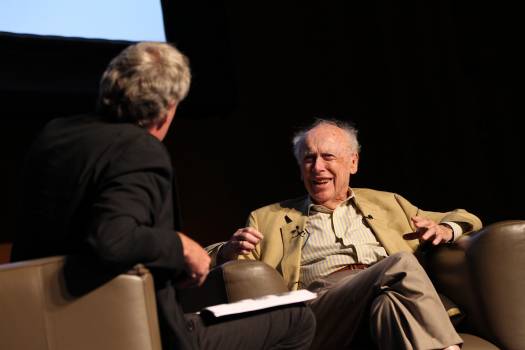
A conversation with James Watson

Professor James Watson, co-discoverer of the struture of DNA

Prof. James Watson co-discovered the structure of DNA in the 50’s with Dr. Frances Crick. He is quite an incredible man- at 84yrs of age, he is still active in research today!

The talk was a ‘conversation with James Watson’. It was very interesting. He can be quite controversal though.

He wrote a book called How to Avoid Boring People; one interest thing he said was to avoid being in a room with more than 2 Nobel Laureates (you have to laugh at the likelihood of that happening).

Watson said he hated going to the Nobel meetings because you end up with 10 Nobel Laureates in a room and they are incredibly boring. He snorted thinking you’d have to be boring to be one and that he was the exception.

It was amazing to get the opportunity to see him.

Dr. Craig Venter: ‘From Reading to Writing the Genetic Code’

Dr. Craig Venter, the background shows the cover of Science, the journal in which his group published their sequencing of the human genome in 2000

Dr. Craig Venter, sometimes called the ‘bad boy’ of science, was involved in the sequencing of the human genome. There were two groups racing to sequence the human genome at the time; the public group led by Dr. Frances Collins and the private group lead by Venter.

Venter had declared to the public group that his company could sequence the genome faster and for cheaper than they could. This kicked off the race between the two groups, leading to the genome being sequenced far faster than the public group had estimated it would be (3yrs ahead of the expected time-frame).

Craig Venter’s synthetic micro-organism, a bacteria called Mycoplasma mycoides JCVI-syn1.0

In recent years, more famously perhaps, Venter’s research group made the first synthetic organism.

It was very interesting to hear what his group (or an assembly of many groups) was up to and also to hear his thoughts on the future of science. 

He believes, for example, that in the future, during disease outbreaks, it will be possible for people to download vaccines from the internet and use boxes, containing his technology, to synthesize the vaccines themselves.

What an amazing thought eh? And not that farfetched.

Prof. Brian Greene: ‘The State of String Theory’

Professor Brian Greene

This was an incredible talk (even though I don’t do or understand Physics!). I am fascinated by the science of the universe.

Did you know- the heavy elements in our body came from the heart of an exploding star? All the particles that make up this universe have always been and always will be; how incredible is that?

It leaves you with a sense of belonging to the universe.

Prof. Greene also mentioned the multiverse- the notion that we are only one of many universes.

If these multple universes exist, it is believed that they would collide with one another and cause ripples to pass through each universe. 

Prof. Greene said, if we could detect these ripples, we could prove the existence of other universes. He said people were working on searching for these ripples (and they would be possible to find, if they exist).

Wow.

The infamous strings of String Theory… hypothecially!

Specifically though, Prof. Greene was talking about String Theory.

The idea behind it is that, if proven, it would be the unifying theory of physics- explaining all the parts that make up the whole universe and the energy in it.

It is a very complicated idea, and one that I can’t explain- so I found this brilliant TED talk that Prof. Greene gave (and it’s very similar, down to the letter in some parts, to the talk I heard). It’s about 20mins long, but it’s fascinating and he explains it in a clear way, so it’s easy to follow, if you are interested, I highly recommend it!

I left his talk feeling invigorated, awed and amazed. I had to jot down all I could remember.

Prof. Rolf-Dieter Heuer: The search for a deeper understanding of our universe at the Large Haldron Collider: the world’s largest particle accelerator

Large Haldron Collider at CERN

I couldn’t miss this talk. CERN is all over the media at the moment.

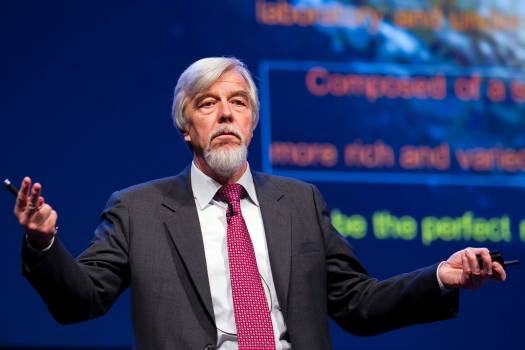
Prof. Rolf-Dieter Heuer (a particle physicist and Director General of CERN) was talking about the Higgs Boson. Which he said, if you ask him professionally he would say, ‘we have probably found it’, if you ask him personally he would say, ‘we have found it’.

Scientists, we are always so careful!

Professor Rolf-Dieter Heuer, Director General of CERN

He was a brilliant speaker, very funny and very interesting.

Professor Peter Higgs, Theoretical Physicist who first predicted the existence of the Higgs boson

Briefly (and in a very simple way, because I am no physicist!), the Higgs Boson, when found (as it likely has been), would prove the existence of the Higgs field.

The Higgs field is the way a particle gains mass (by interacting with the field). The stronger the interaction with the field, the larger the mass of the particle.

The field also has a peculiarity, in that, it can interact with itself.

So, again, a particle gains mass by interacting with the Higgs field, in theory, but in order to prove that the field exists at all- you must find the Higgs boson.

But why?

Why would finding the Higgs boson prove the existence of the Higgs field?

Prof. Heuer had a brilliant way of explaining the reason why:

He used this analogy: if he walked into a room full of journalists (representing the Higgs field). He could pass through the crowd, unnoticed, because they don’t know who he is.

The journalists don’t react to him.

Professor Rolf-Dieter Heuer, Director General of CERN… pointing!

However, if Einstein passes through the crowd, the journalists will react and crowd in on him.

And so Einstein gains mass (which is what the Higgs field does to particles).

The more known to the journalists, the more massive that person becomes (as they are all crowding in on them).

This is an explanation of how a particle gets mass in the Higgs field.

But, Prof. Heuer said, if for example he whispers a rumour into the room of journalists. They start to crowd in on each other, saying, “what did he say? Oh? Who?”.

This is a self-interaction of the field.

This forms the Higgs boson- self-interaction of the Higgs field= Higgs boson!

WOW! We all cheered. What a perfectly simple explanation of something I did not understand at all.

Professor Rolf-Dieter Heuer, Director General of CERN
“So, particle physics is really easy!!”

After he explained this, Prof. Heuer said: “So, particle physics is really easy!” (His wry smile implied he was making a funny; everyone laughed).

You might wonder, this is all very well and good, but how does the Higgs boson help us really?

Well, Prof. Heuer made this point; the internet was developed in the 80s at CERN. It was developed by the scientists so they could transmit their research to one another in a quick manner. At the time, they didn’t envisage any other purpose for the internet. But in later years, obviously they realised it could be used for other things. And it was only later that other uses became known.

Prof. Heuer doesn’t know yet what the Higgs boson can be used for, but in the future who knows?

I really loved this talk.

Prof. Heuer is amazing. I want to go to CERN and follow him around and have cups of tea with him and get him to tell me about the universe!

Would it freak him out? If I was in his shadow, with a cup of tea in one hand and a notepad in the other, going:

“Okay Rolf, tell me about the universe!” Latimer

“How did you get in here?!” Rolf

“I live here now…” Latimer

“Security!” Rolf

“Shush; I locked them in the Large Hadron Collider- anyway, let’s talk physics!” Latimer.

Ha…

‘What does Art bring to Science?’

Moving away from Physics now, I also went to a series of talks on; ‘What does art bring to science?’

The most interesting of these was the story of an American painter, William Utermohlen, who had been diagnosed with Alzheimer’s disease. This of course is incredibly sad, but Mr. Utermohlen gave a valuable, as before unseen insight into this progressive, destructive disease, by charting its progression with his self-portraits:

I found them haunting and somewhat disturbing to be honest, particularly the final portrait. It does illustrate a clear decline though, in a media that had not previously been shown.

It gaves the disease a very human element.

This was a very interesting talk; Mr. Utermohlen’s story really stuck with me.

Prof. Christian Keysers: ‘The Empathic Brain’

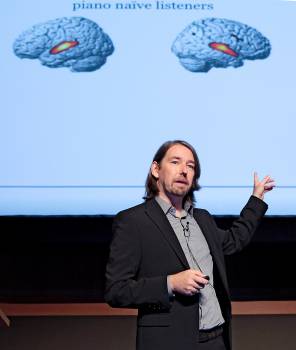
Professor Christain Keysers

Carrying on from this, I delved a bit more into the brain.

This was a brilliant talk about the biological basis of empathy.  Prof. Keysers gave an overview of empathy research.

He explained to us that empathy is not localised in a single area of the brain, rather empathy for different things is localised in different areas of the brain.

So,  people with damage to the brain, could loose the ability to feel certain types of empathy, but retain the ability to feel other types.

In terms of loosing the ability to feel empathy, Prof. Keysers said, if you loose the ability to feel e.g. disgusted, then you also loose the ability to feel the empathic disgust of others.

There was an interesting study carried out, where two groups, one male one female, were shown a card game. While they watched, the researchers monitored their brain activity.

The groups were shown a person playing fair and a person cheating, and winning. The cheater was punished and given an electric shock.

While watching the fair plays, both men and women had the same empathy levels. While watching the cheater being shocked, women had slightly reduced empathy, but they still had some empathy (sharing the cheater’s pain at being shocked).

However, men had no empathy while watching the cheater being shocked- in fact, it had activated a reward sensation in the brain! Indicating that the men were happy to see the cheater being punished, while the women were still empathising with the pain the cheater felt!

This begged the question of men and war, versus women and war. That perhaps there might be more psychological impact on women and this perhaps should be monitored more carefully.

Interesting right?

There was also a study carried out on ‘reading about emotions’. This study showed that people could empathise by reading; for example, they had a paragraph describing something disgusting and people felt disgusted by reading it.

The study suggested that people who read more may have more heightened empathy; but the reason why is not known.

Is it because people read more, that they have more empathy? Or is that they get more out of reading because they have the ability to empathise more with the characters (and that’s why they read more)?

Prof. Keyser mentioned something his old poetry teacher, from school, told him and it sort of stuck with me in terms of writing.

The teacher said that if you want to describe a person sailing on the ocean for the first time, don’t tell your readers what the ocean looks like, they already know- tell them about the person.

Tell them about their expressions. This is more informative, because this way they empathise more.

And in a scientific sense, you are activating the right parts of a person’s brain to feel attachment to your characters. So talk about the person, not the scenery.

Prof. Keyser wrote a book called The Empathic Brain and it’s a self-published one.

It describes an overview of empathy studies (not just his own). I haven’t read it, I did buy it though, it’s waiting on the Kindle- with many others, ha. But he said it was for everyone, so it’s not written in an overly scientific way.

Well, the conference was absolutely amazing.

I wanted to share some of the things I learned, though I appreciate that I might have rambled on a little. I hope it was clear and maybe a bit interesting in some way!

Being at this conference reaffirmed my love for science 🙂